
I’ve met different types and levels of food guarders. Some guard their food bowl only while eating, others guard an empty bowl or the area he eats. I’ve met a dog that would snarl 3 feet away if you have a piece of treat in your hand. I thought it would be a good idea to share my recent experience with my foster while it is still fresh and vivid in my head. I don’t have a before video for the reasons I explain below. So you just have to take my word for that he does guard his food, crate, bones, bowl and bed where he’s eaten before. He gave me the first sign of resource guarding just two seconds after I put him in my car at the animal control. He was too stressed to take treats inside the facility but when I offered a piece in the car, he paused, slowly looked up just with his eye balls, quickly took it from my hand then turned around to eat it. I remember having the “oh-oh” feeling.
One of the reasons I didn’t capture his before videos, besides for the safety reason, was that I did not want the behavior to get reinforced by having him repeat it. Each time he successfully guards his food (the human backs off) it gets reinforced (will guard again in the future). I also felt that I would lose a little bit of trust each time he has to guard from me. I go slow with all my training but I go extra slow with food guarders. I put together a video of our training progress and posted below. I was hoping this might help you understand that it’s about trust, not about you being the boss. Just like my other training videos, this is another “Watch paint dry” kind of video. If you are not into that, I recommend you skip the video.
After I established a better relationship with him, I once purposely pushed him slightly over the threshold and did not back off. It was because: 1. I wanted to do an assessment prior to adoption. 2. I had a safety/management protocol in case he guarded (which he did) 3. I was willing to go back to square 1 if needed. 4. I find that dogs are more “forgiving” when there is more positive relationship established prior to an incident. He did forgive me and we were ale to move forward after the minor set-back. By the way, I’m only talking about food guarding from humans here. He also guards from other dogs but that’s going to be another blog post.
Assess-a-hand
Sue Sternberg developed a testing tool called “Assess-a-pet” hand which are being used to test food guarding in shelters and by trainers. I have an “Assess-a-pet” but I don’t use it to test whether a new dog will guard or not. You can usually tell that without sticking a hand in a food bowl. However, I have used it to counter condition to a hand safely. I personally don’t recommend using this tool IF you are a rescue person and trying to evaluate a strange dog in a stressful shelter environment. I would get the dog used to the hand first separately, then use it to test, if necessary.
Finn
Assessment
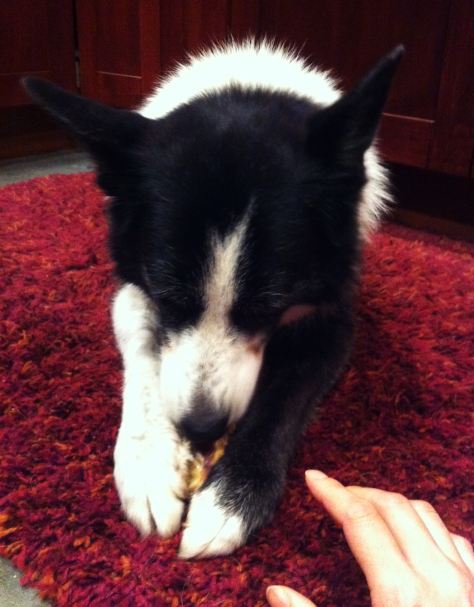
He guarded things related to feeding; crate, bed, bowl, food, bone, Kong, a piece of kibble, eating area and manners minder. He jumps on top of the item while giving one loud bark, keeps his muzzle on the item, then freezes/whale-eyes until you leave. If you continue to approach, ignoring his signals, he would growl, snarl and snap. If pushed, he will most likely bite depending on who. His reactions looked well practiced. He was an owner surrender to an animal control and he came with so many behavior problems. I believe this was one of the main reasons. However, I would not consider him very high risk to experienced owners as he gives plenty of warning signals and his behaviors are manageable and modifiable.
Management
- He did not eat out of food bowl for 4 weeks – all out of my hand or through counter conditioning
- After week 3, He was allowed to have a stuffed Kong and a bone in his crate (to work on separation issue) behind a closed door or a gate. He had two barriers from other dogs.
- All bones and Kongs in the living area were picked up when he was loose, unless we were training
- He got to eat an entire meal in a bowl after week 6, still part of training
- Set it up so that he does not HAVE TO guard his food – careful planning
Counter conditioning and teaching new skills
- Teach him that food continuously comes from my hand
- Teach him that my hand delivers food under his head on the floor – the area he was most guard-y with
- Teach him a cue “Treat” – a signal for placing my hand in the hot spot with more food
- Teach him “Bring” “Drop” “Get it” – with non-food items first
- 1000s of repetitions – I approach, you get more
- Reverse psychology – You steal – good boy! Can you show me?
- Teach an incompatible behavior – Look up, Sit, Come, Touch. I didn’t encourage down initially as he, without a fail, downs with his paws wrapping the bowl around.
- Video tape the sessions to observe his body language
Today He trusts me around his food but it doesn’t mean he will do the same for others. His new person has to earn his trust just like I did and use management as long as necessary. So what’s easier? Prevention! Do it before your dog learns to guard his food. And don’t take your trusting dog for granted.
Recommendedbook on resource guarding
 Bordernerd
Bravo! I missed this one of yours. The work of thousands of reps! That’s the funny thing about longterm classical conditioning protocols, you just can’t show on video the work that it took. I like your solution; it was great seeing all the different movements and stuff you did, labeled. I have been doing DS/CC work with my feral dog for 15 MONTHS now but have virtually no video to show for it. The results are wonderful but I don’t have any “before” footage since my teacher and I were way too busy in the sessions….it was way too intense at first with a growling little puppy. I may try the approach you used in your vid. Great job.
Eileen, I really appreciate this comment. You can relate only if you have experienced it yourself. Great work with your feral dog!