
This post was intended for dog owners with a high energy, destructive and young dog Many of you know how I much I like using food to train. Dogs must eat to live, why not use it to get behaviors? But I LOVE using toys to train dogs even more. If you ever worked with working dogs, you understand how exhilarating it is to use toys to get behaviors you want. There is a whole another level of focus you can get when you use play as reward. Well trained search dogs look for a missing person for hours not just because they love people.
They do it to get that tug toy in your backpack. All a narcotic dog thinks about is the toy at the end of search. With my foster Finn, play/toys were the keys to his rehabilitation. He would not have been where he is today unless we had gotten him hooked to the interactive play. He now retrieves a bone he used to guard from me and through play he learned not to snap when I restrain him. But what if your dog does not play with toys? Sure, your dog might be one of those who just doesn’t care about toys period. But have you really tried introducing him to the joy of interactive play? I recently met a rescue Chihuahua that turned out to have the most amazing tug drive and a little shy Doxie who fetches forever. And guess what, dogs can’t fetch and tug by themselves, they need you to make it happen. Just because you have toy breeds, it doesn’t mean they will only be your lap dog. These dogs, with the right guidance, have the biggest potential to be focused, exercised and well behaved companion dogs.
Pet owners buy expensive rope toys, stuffed toys and balls, hoping that will exercise them and teach them not to chew on things. Some dogs, usually the ones that are curious and mouthy, will pick up the toys and play with them. Many dogs could care less and still chose to “play” with your shoes and kids toys. Owners then claim that their dogs don’t like “toys”…and can’t be trusted in the house.
4 things to point out here.
- Leaving those expensive so called “dog toys” on the floor doesn’t necessary teach the dogs to play with them. Dogs didn’t read the book “What are dog toys?” before coming to you.
- If he can’t get enough outlet for mouthing, chasing and running, where is he going to get it from? Your pant legs?
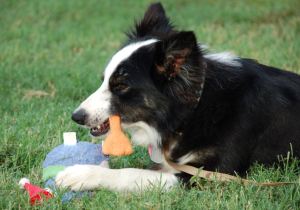
- When do most pet dogs get attention from humans? It’s when they do something “wrong”. What happens when your dog grabs your kid’s toy? Suddenly you and your kid are chasing after him, but never when he’s chewing on his rope toy. There’s his fix for “chase game”! For some dogs, any attention is a good attention.
- A young and energetic dog does not get enough exercise just by squeaking and tossing a stuffed toy in the house. He needs to have aerobics and interactive play.
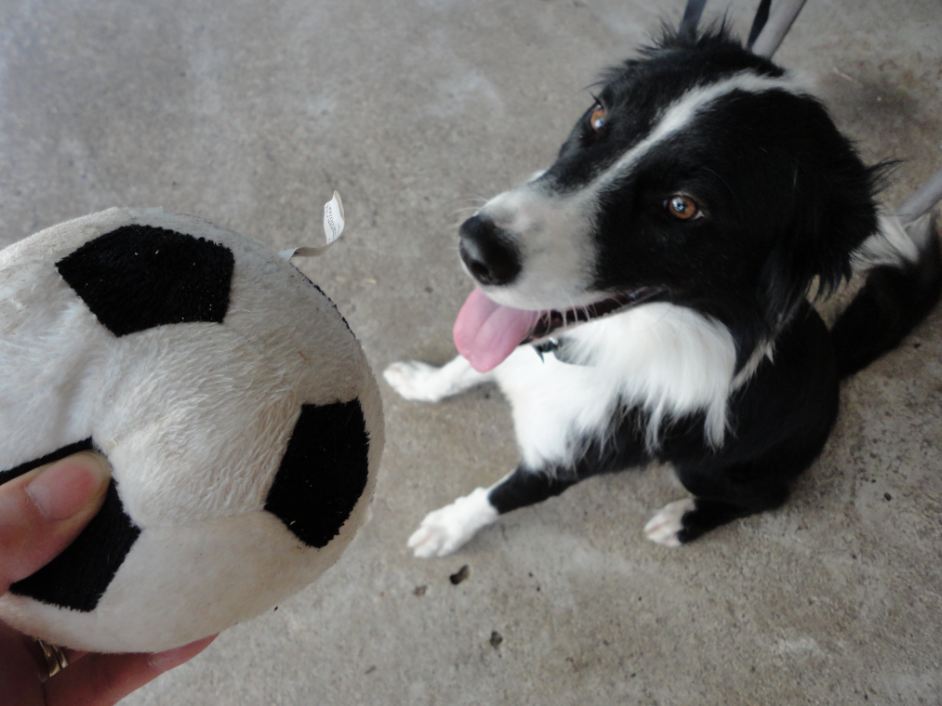
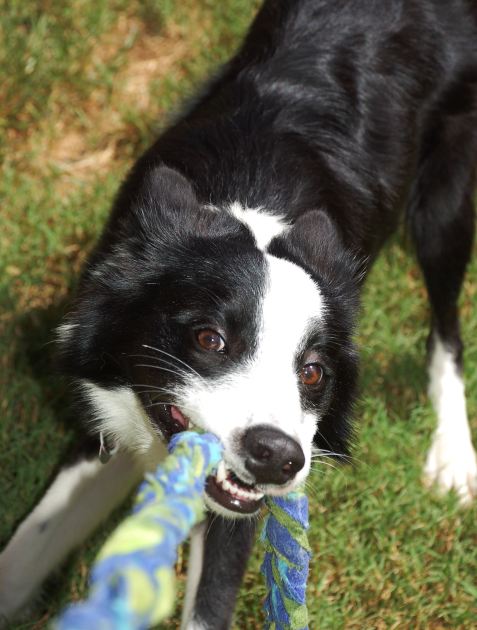
So how is “interactive play” different from regular “play”? Interactive play is where another party (I prefer it to be the owner, not the other dog) interact with the dog through body movement, running, chasing, tugging, fetching, and so on. Not only does it provide the much needed physical exercise, it also builds a much stronger bond between you and your dog. Because you have a control over the toys that he likes, you have a control over his behaviors too. If he likes to play tug, you can get him to sit, down, come or wait before initiating a tug-of-war. If he is obsessed about chasing a fluffy toy on a string then you can use it to call him off from a neighbor’s cat. But if you leave all his toys on the floor 24/7, do you have a control over them? No. And the toys dead on the floor are a lot less interesting compared to the toys that are alive in your hand.
Getting a behavior that you can use
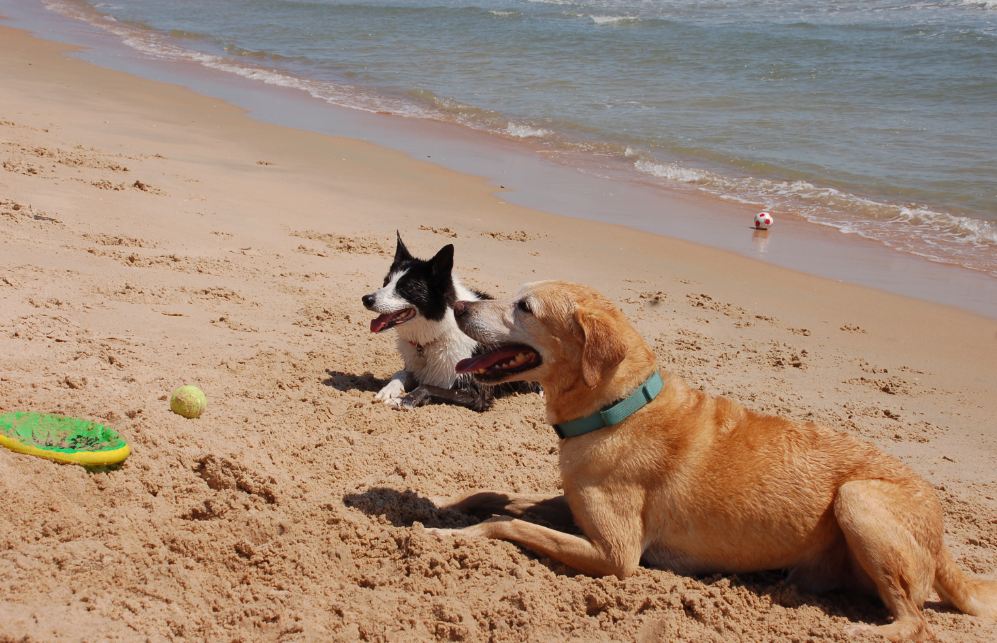
Dog training isn’t about “Sit” and “Down”. They already know how to do that. The question is would they do that when you need them to? And the biggest question is why/how we use these behaviors? I like practical training. I teach my dogs “Sit” on cue for a number of practical applications. I teach my dog to “back up” so that I can see my TV screen without a Border Collie staring at me. “Catch” can be used to give monthly pills. “Get it” so that I don’t have to bend over to pick up my keys with my bad back. All of these and more can be reinforced using play. If you want to play with me, do ____. If you want to play tug, “Get it”! “Back” and I’ll throw a ball for you, etc.
How about interactive play with other dogs?
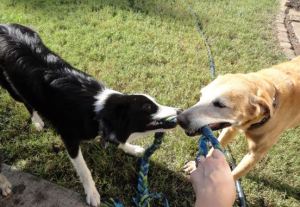
I’ve mentioned this briefly before. I discourage my dogs to play physically (chasing, wresting, jumping without a tug toy) with other dogs unless I think it has a greater benefit to all involved. I like my dogs to be more people oriented because it makes the training much easier. If a dog discovers that other dogs are more fun than you/people, how difficult is it to get his attention back to you? No human is capable of running, wrestling and chasing like a young playful dog. I want my dogs to believe that I’m the one that produces all things fun including the interaction with other dogs. Once I have that bond, association and control, I do let my dogs play with other dogs, preferably with toys. But they still prefer me over other dogs to this day because of the reinforcement history. The video below shows an example of my dogs seeing me as the source of fun. I sort of act as an on-off switch to them. When I appear, play happens. When I disappear, fun is over. I’ve watched them on a webcam during the day so I know they never play together unless one of us is home. Don’t get me wrong, they get along perfectly and respectfully with each another. When we are home, they only play if we are part of the play. I LOVE that kind of relationship with dogs. It can be achieved through controlled/interactive play. Once I hook a new dog to interactive toy/play, I make it even more valuable by putting it where he can’t get until “I” decide to use it. When we go outside, I give a cue “Go potty” (Another useful behavior to reinforce with play) and wait. When he goes both #1 and #2, then he finally gets that toy from me.
My favorite types of interactive toys
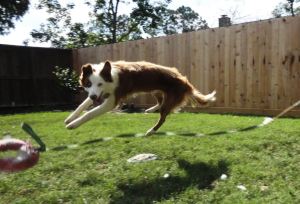
***These toys should be put up when YOU are done playing. Water hose can be a great interactive toy too! They are not chew toys.
 | 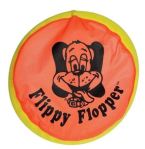 | 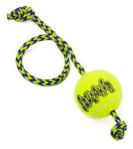 | 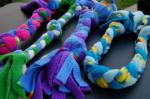 |
| Whip toy | Floppy Frisbee | A squeaky ball on a string | Any long rope toy |
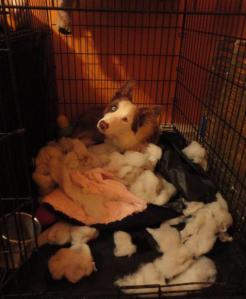
Destructiveness/High energy
Finn is VERY destructive and used to chew up anything in his crate. Because I just refused to leave him in his crate on a hard floor, we went through so many different types of mats and liners…each one got sturdier than the last. I can now trust him loose in a room with at night but it took months to get there.
- Get him addicted to interactive play. Tugging, fetching, Frisbee, chasing a toy, water play and jumping on cue. Because of his desire to play with me, I was able to get so many behaviors on cue. Without these rigorous exercises outside, I could not have taught him to settle down in the house. The first time he played tug with me, I cried. Because I knew how significant that meant.
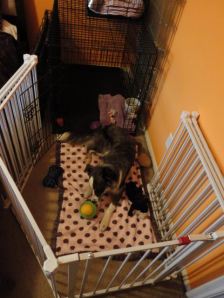 house. A stuffed kong, a water bottle in a sock, scented rope toy and rubber toys are great choices as long as the dogs don’t eat them. I avoid squeaky toys as they drive my husband crazy! Once you hook them to chew toys, gradually add items that he’s not supposed to chew. If you are serious, put one of your expensive shoe or your glasses in the mix. That’s going to force you to monitor him carefully. If he shows interest to your shoe, ask him to “Leave it” and direct him to the approved toys. Lots of praise and reward when he does go for his toys. I like to use stuffed Kongs with food to speed up the process. Dogs will learn that rubber toys are definitely “approved”. Stuffed and certain fabric toys as non-interactive toys can be confusing to some dogs. How is he going to distinguish between his toys and your kid’s stuffed animal?
Here are steps of gradual transitioning for stressed and high energy dog.
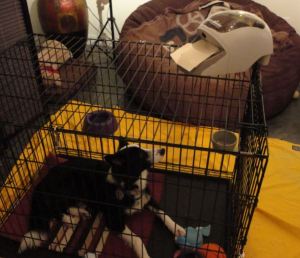 | 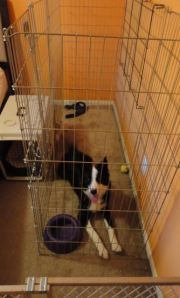 | 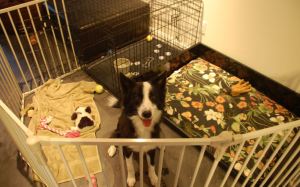 |
| Large crate during detox | Large pen with a few chew toys (No bones until his resource guarding is under control) | Crate, chew toys and a bed inside a pen |
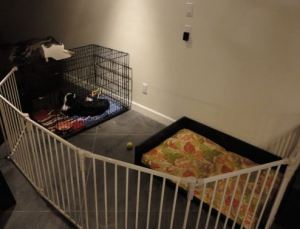 | 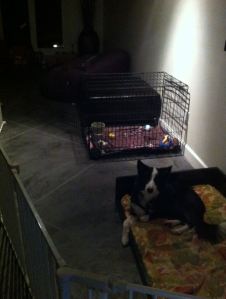 | 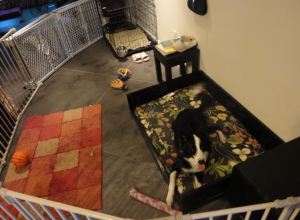 |
| Crate, bed, toys, chews in a larger area | Area is now expanded to another room where we train | “Apartment” – my purse, books and a pair of shoes are added as well as a large rug for potty training purpose. |
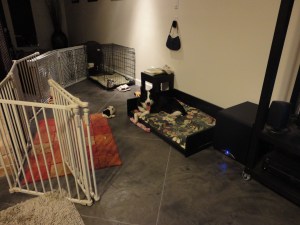 | 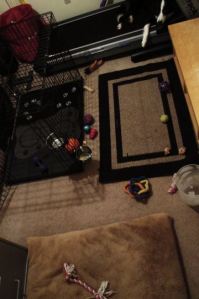 |  |
| When I can watch him his pen is left open. Because of the routine and reinforcement history, he prefers to stay there. | A large crate moved into a doggy proofed room. Crate is left open at night. He no longer destroys the bed/mat/rug. Tons of chew toys, bones, interactive food dispensers available at all times. | Finally free! |
Other useful “tools”
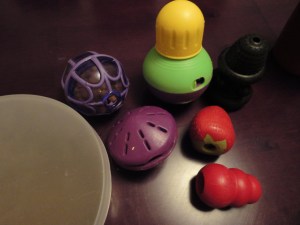 Interactive food dispensers (Different from interactive toys) They are left with dogs to mentally stimulate and prevent boredom. | |
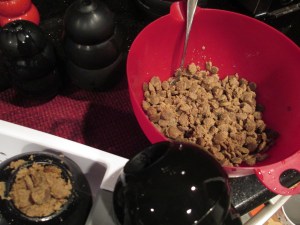 Frozen kibbles in a Kong | 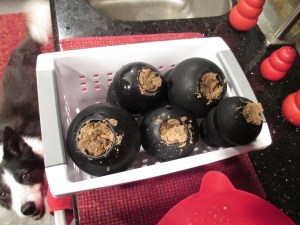 |
 If all fails…a glass of wine and “through the dog’s ear” for you… |
 Bordernerd
I have delayed responding to this because there is so much awesomeness here that I can’t possibly say enough. First, I have never seen anything remotely like that video. What a very interesting idea. I am afraid that when I got my puppy Clara, since I had three other dogs and she was “unplanned”, I was very relieved when one of them would play with her and encouraged it as much as I could. It removed some of the burden on me. It happened to work out all right; all my dogs are much more focused on me than they are on each other, and Clara most of all. But I think that is partly luck and that no two of them are particularly compatible. She is a very sociable dog and that could have been a problem. I’m going to keep your comments in mind for the future….
I think the series of pics expanding the dog’s world are wonderful and I wish every pet owner could see them. So useful for visual people to see the stages. Wow, and actually deliberately putting items that are not for him in the space in the last stages and using the space to teach the difference. Brilliant.
Thanks for a wonderful post. Good sound advice and ideas as always. I’m going to share it on my FaceBook page.
Eileen,
I hesitated to post this. I figured most people wouldn’t read such a long post. But I knew if anyone would “get it” you would. :) Thanks for noticing the significance of the little things.
P.S. Chuckling @ “unplanned”.
good sound advice..I have two Australian shepherds…the most wonderfull companions. They are 13 and 12 years old. I love your clip showing the dogs in action.
Thanks! I love Aussies too. :)
thanks for this fabulous post so many adwices and ideas for me
Thanks Daniele! Glad you enjoyed. :))
Aki,
This is a truely amazing and inspiring post. We give our dogs free access to all toys and I have noticed that they only play together with interactive toys if we are present. When we leave… playing stops. I never really put it together until I saw this post. My dogs do the EXACT same thing. I only wish I was half the dog expert that you are! Thanks for a great read. I’m sharing!
Sounds like your dogs also see you as the source of fun! What I’d do is pick up the ones they love the most, and use them to reward the behaviors you like. For instance, if your dog is shy or nervous around people/other dogs, you can use them to counter condition the fear of ____ in addition/in lieu of food. The more things you can use to reward the better. Have fun and thanks!